
12. 10. 2026
A higher rent does not have to mean a more expensive office. It is not just the price per square metre that determines the actual costs
When choosing new offices, companies often start by comparing the rent per square metre. It is precisely because of this that modern office buildings can, at first glance, appear to be the more expensive option. However, the rent alone does not indicate how much the company will actually be paying for the offices. A lower price per metre may be outweighed by higher operating and energy costs or by the company having to rent and construct more of its own facilities. Also, the total costs also include expenses associated with fitting out the new premises and relocating. Therefore, according to Passerinvest Group, an office with a higher basic rent can, in the end, work out cheaper than one with a lower price per square metre.
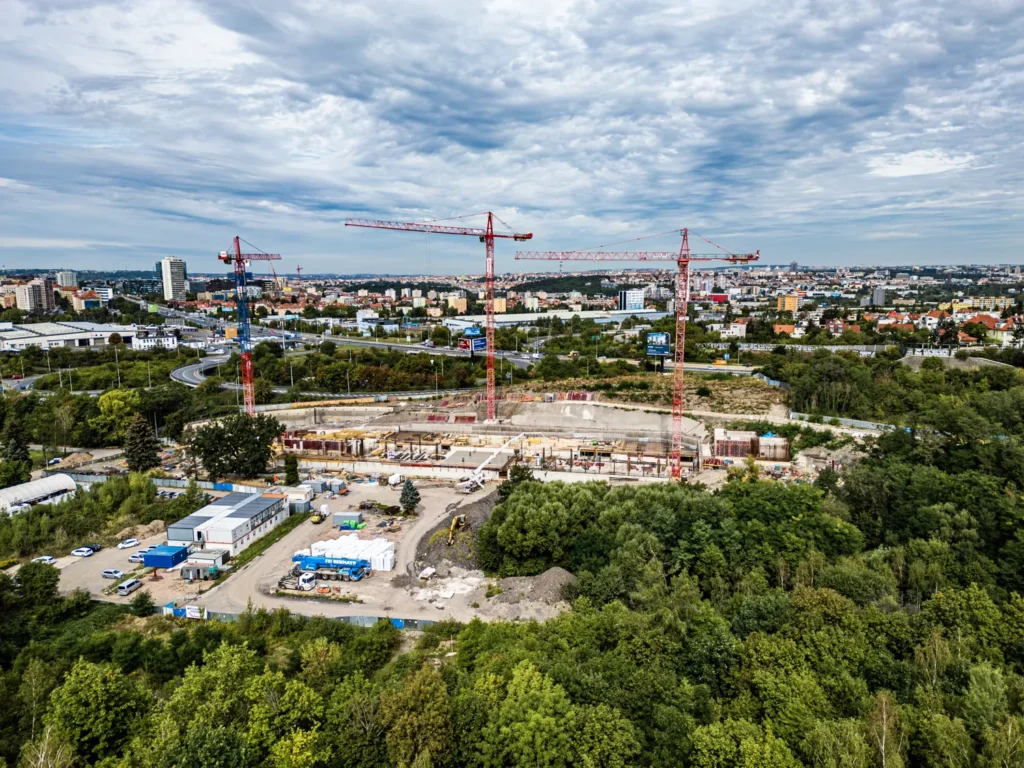
The difference can already be seen in the regular monthly building operating costs. Passerinvest Group shows this using the example of the Sequoia office building that is under development in the Nové Roztyly district of Prague, where it anticipates that the estimated service charge will by CZK 87 per m² per month for 2027. Energy consumption within the tenant’s premises is billed separately and is estimated to be a further CZK 24 per m² approximately. According to the company, in many high-quality office buildings in Prague, the service charges alone range between CZK 120 and CZK 160 per m² per month, and direct utility consumption must also be added on top of that. A difference of a few tens of crowns per square metre may appear small, but over larger leased areas this can amount to millions of crowns a year.
“If a company rents 10,000 m², a difference of CZK 40 per square metre means 4.8 million crowns a year. For a ten-year lease, we’re talking about a sum that shouldn’t just be tucked away as a footnote under the rent amount. That is why, when we’re talking to clients about office costs, we try not to look just at the headline rent. For me, the more important question is how much the company will actually pay for its offices each month and how much they will cost over the entire term of the lease. Once we add service charges, energy, fit-out and incentives to the calculation, the comparison between new and older buildings becomes much more interesting,” explains Eduard Forejt, Director of Business Development at Passerinvest Group.
Energy consumption also has a significant impact on operating costs
Energy also makes up a significant proportion of an office’s regular operating costs. Its consumption is also influenced by the design of the building itself and the way in which technologies providing, for example, heating, cooling or automatic indoor climate control, function together
Therefore, in the Sequoia project Passerinvest Group anticipates using a combination of heat pumps, photovoltaic systems, radiant ceilings, external blinds and smart building management. The aim is to reduce total energy consumption to approximately 30 kWh/m² a year, while maintaining a high level of comfort for users. The building is also aiming for BREEAM Outstanding certification and compliance with the EU taxonomy requirements.
“In my opinion, sustainability is best assessed during day-to-day operation. We may have the highest-level certifications, but ultimately what counts is how much energy a building needs, how it manages its water use, how efficiently its technology functions and what operating costs it incurs. That is why, with the Sequoia project, we are treating the building as a single entity. Each technical decision must make sense not only in its own right but also in relation to the other systems,” explains Petr Bečán, Senior Technical Manager & ESG at Passerinvest Group.
Companies can also save money by renting less space
The size of the leased space also significantly affects overall office costs. Companies often pay for space that they use only occasionally. A typical example are large meeting or conference rooms that are only needed a few times a month. They may be empty the rest of the time, but the company is constantly paying rent, service charges and energy consumption for them.
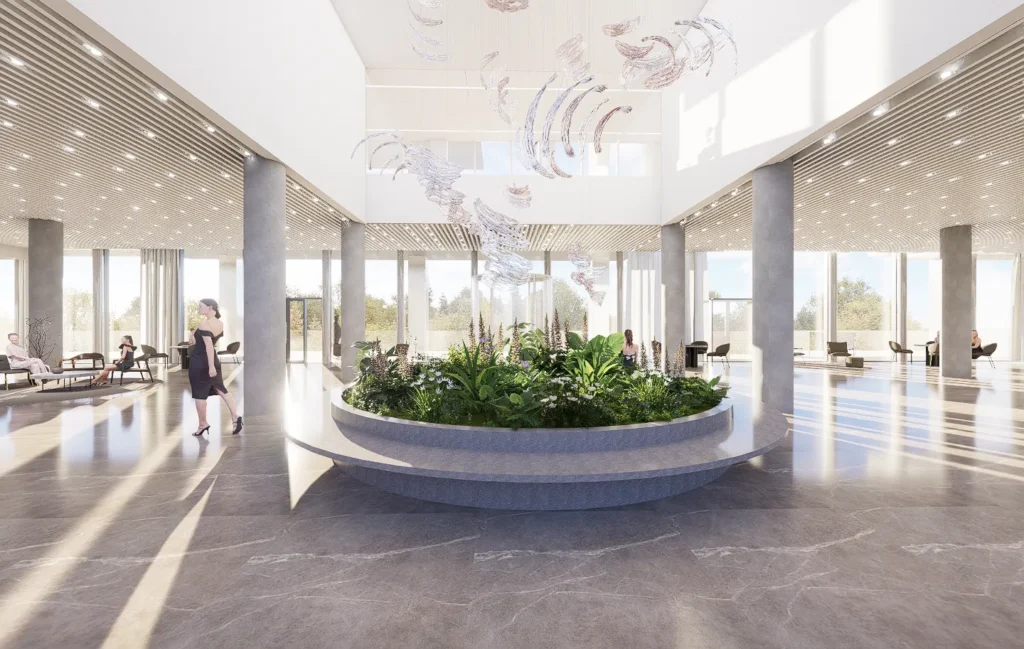
Shared meeting spaces with a capacity for up to 200 people will therefore be created in the Sequoia office building. This means that tenants can design their own offices according to what they actually use each day and make use of larger spaces that are required only occasionally as part of the building’s communal facilities.
“If, thanks to shared spaces, a company does not need, for example, 150 or 200 m² of its own conference facilities, it does not just save on the rent. Nor does it have to construct this space, fit it out, cool it, clean it and then maintain it over the long term. Therefore, when you are assessing the efficiency of offices, it is not only important how much they cost per square metre, but also how many metres the company actually needs. A large meeting room used once a week still costs money for the rest of the time when it remains empty. If such a facility can be shared across the whole building, a company can easily save on part of its expenses,” says Eduard Forejt.
Companies may be put off relocating by the costs of fitting out and equipping offices
When comparing new and existing offices it is necessary to also bear in mind the costs that may, on the contrary, point in favour of remaining at one’s current address. One of the largest expenses is the construction and fitting out of new office spaces to meet a company’s specific needs. According to Passerinvest Group, in the case of larger companies this can involve an investment running into the tens, sometimes even hundreds of millions of crowns. Further expenses are incurred with the move itself, furniture, AV equipment and the provision of technical and IT infrastructure in the new premises.
It is precisely the high initial investment that can be one of the main reasons why a company decides to stay in its current premises. For new projects, however, the landlord can help with this obstacle. As well as the standard incentives, such as a period without payment of rent, it can contribute directly to the construction and fitting out of new offices or, in the case of a long-term tenancy, finance a significant part of this investment.
Passerinvest Group is also working with this model for the Sequia project. Depending on the length of the lease agreement and the rent amount, the lessor may cover part of the costs of constructing and fitting out the offices and spread part over the rent. In this way, the company does not have to pay the whole substantial investment right at the start. In some cases, the lessor may even cover the initial costs of constructing the offices in full. A combination of incentives for constructing offices and rent-free periods can therefore significantly reduce the overall costs of relocating.
“Of course, this does not mean that a higher rent is automatically more advantageous. It means that a higher rent can be part of a cheaper solution. For a finance director, spending, for example, fifty million crowns today on new offices is not the same as spreading the same investment over a ten-year lease through the owner of the building. Especially if, at the same time, they are moving into a building that should be generating lower operating and energy bills throughout that period,” says Eduard Forejt.
Therefore, according to Passerinvest Group, it cannot simply be said that a new office building is always more advantageous than an older one. But, likewise, a lower rent does not automatically mean a cheaper office. When comparing individual offers, you need to look at the costs across the board – from the rent and regular operating costs, through the size of the leased area, to the initial investment associated with relocating and the fitting out of the new premises. The important thing is how much the company will actually pay for the offices over the entire lease period. There is no doubt that a new building is the more comfortable, higher-quality and more sustainable solution, but only this perspective will show which option is more cost-effective for the company in the long run.


For more information and photos in print quality, please contact us.
Kristýna Samková
Head of PR and Marketing department
Kamila Žitňáková
Crest Communications a.s.
PASSERINVEST GROUP, a. s.
Passerinvest Group (hereinafter Passerinvest) is a purely Czech builder and investor. The company was founded by Radim Passer back in 1991 and has since then acquired a lot of experience in the construction of office and commercial buildings, residential buildings and civic amenities.
Since 1998, Passerinvest, as a responsible urban developer, has primarily been connected with Brumlovka (BB Centrum) in Prague 4, which is one of the most successful and extensive urban projects not only in the Czech Republic, but throughout all of Europe. Another important project in the company’s portfolio is Nové Roztyly, a brownfield of the former slaughterhouses of the Interlov complex where, in the future, a place with pleasant housing with a large park should arise, complemented by services for the general public and an office function. The principles of urban construction and the long-term sustainable development of Prague and the Czech Republic are part of Passerinvest Group’s vision. Thanks to its responsible approach, Passerinvest has built a very good reputation both on a domestic and on an international level. This is not only to the credit of the quality of the realised projects and the high level of the provided services, but also to the sense of fair play, a customer approach and also its responsibility to the society and the environment.